Designed by Pelagic: From Reef Trails to Reef Navigator.
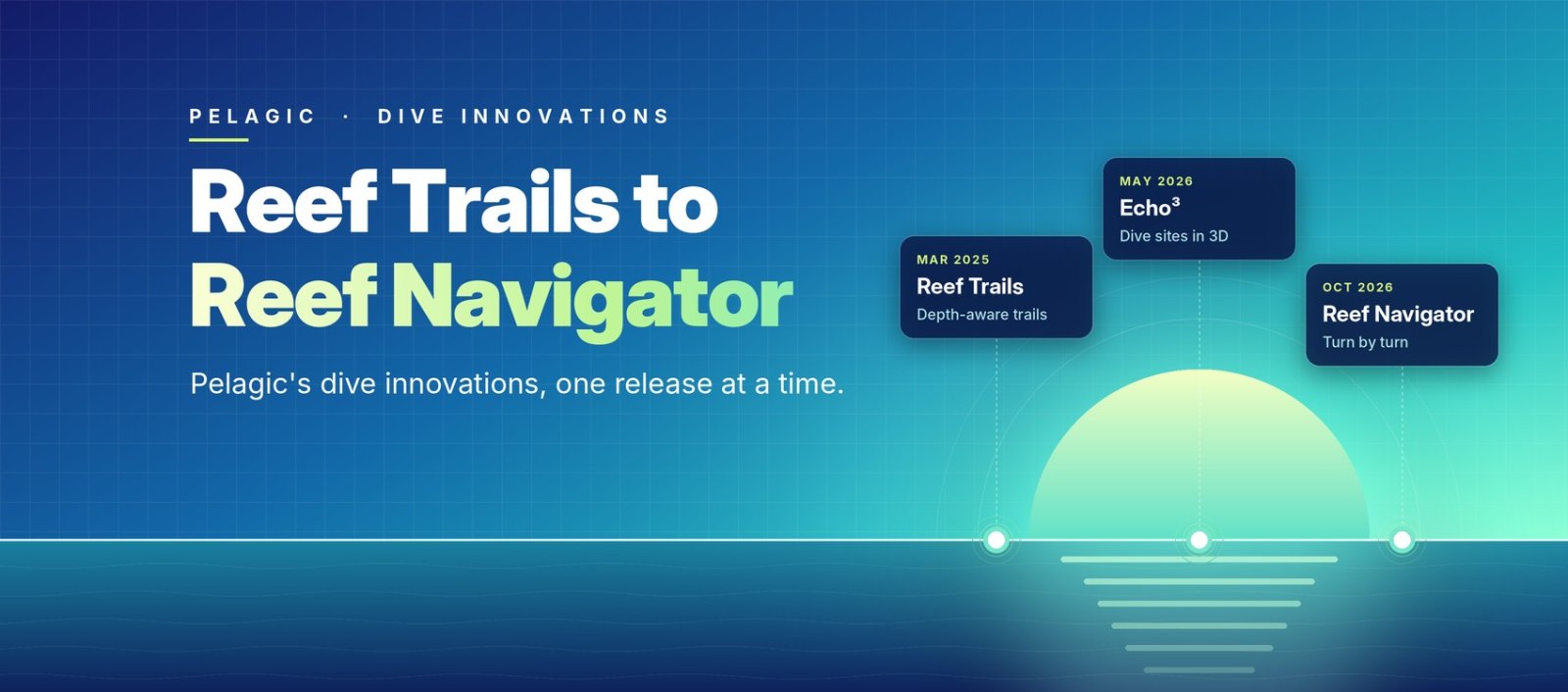
Pelagic was built around one question: how do I dive it best? From your front door to the water's edge, and from the entry point to the best of the reef.
That idea didn't arrive in a single release. It was built in layers, each one making the next possible. This is that story.
March 2025: Reef Trails start it all
It began with a simple idea: a map of underwater trails for divers to follow.
Pelagic pioneered the Reef Trail™ and laid the first one in Sydney. It spread across the city, then along the coast, and today the map carries over 100 of them. Each trail is optimised and depth-aware, guiding you from the entry point to the best of the reef.
The detail that sets them apart: Reef Trails change colour as the route deepens. At a glance you can read the depth profile of the whole dive before you get wet. Designed by Pelagic.
October 2025: Pelagic Azure is born
The next question was visibility. On 17 October 2025, Pelagic Azure, our underwater visibility prediction model, went live with a single visibility prediction for all of Sydney.
It was a start. But visibility is local. A sheltered bay and an exposed headland can be completely different on the same day.
November 2025: Azure goes site by site
Within weeks, Azure grew from one prediction into a full site-by-site model. On 2 November 2025 it launched across 54 Sydney dive sites, each with its own visibility forecast.
It has been refined and calibrated ever since. You can read how it works in our guide to Azure.
Early 2026: Mapping the coast
With Azure running, Pelagic turned its attention north and south. Through early 2026 we surveyed and mapped reefs along the NSW coast, from Jervis Bay to Port Stephens, adding new dive sites for divers to explore.
March 2026: Hadal and site-level forecasts
On 5 March 2026, Pelagic Hadal dive site forecasts launched across Sydney and the Illawarra, forecasting the waves at each dive site, days ahead. Hadal now covers 200+ sites, all mapped by hand.
The open ocean and the waters at the dive site are two different things. Hadal is built around the second one.
On 22 March, Azure followed with multi-day visibility forecasting across all mapped sites. Plan the week, not just the day.
May 2026: Echo³ and NaviCodes
On 1 May 2026, Pelagic launched two of its biggest releases yet.
Echo³™ brought 15 interactive 3D models of Sydney's best dive sites, each custom-built by Pelagic. See every ledge, bommie and drop-off from any angle before you get wet. Echo³ has since expanded across New South Wales. Explore dive sites in 3D.
NaviCode™ puts the dive route on your slate. Created by Pelagic, and available at Sydney's most popular dive sites.
September 2026: Reef Trails go 3D
On 15 September 2026, depth-aware Reef Trails arrived inside Echo³'s 3D dive site models. Follow the route through the terrain, see exactly where it drops away, and know the dive before you jump in.
October 2026: Reef Navigator
Our most innovative release yet. On 4 October 2026, Pelagic launched Reef Navigator™: interactive, turn-by-turn guidance on your phone while you dive, now available at several sites across Sydney.
Reef Navigator guides you along Reef Trails to the best of every mapped reef, and works with no signal. At select sites it's now fully integrated with Echo³, so you can see the reef's terrain in 3D whilst you dive.
No waterproof case? Use a NaviCode on your dive slate.
Pelagic supports good dive planning, but it doesn't replace training or judgement.
What ties it together
Every release answers the same question from a different angle: where to dive, when to go, how to dive it best.
And we're only just getting started. Pelagic is dive intelligence for scuba diving, freediving, snorkelling and spearfishing. If you'd like to see where it goes next, request an invite.