About Avalon
Avalon headland features a steep reef drop-off and rugged underwater terrain, offering adventurous diving with rocky ledges, overhangs, and rich marine life along the exposed point.
Avalon Weather Forecast
About this forecast
7-day weather forecast for Newcastle, NSW sourced from Open-Meteo. Daily high/low temperatures, conditions and rain probability.
Avalon Swell Forecast
About this forecast
Site-specific wave heights adjusted for Avalon's exposure, orientation and depth profile. Colour bands: green = ideal, orange = marginal, red = undiveable.
Avalon Tide Chart
About this chart
Today's tide chart with best on incoming mid to high tide conditions highlighted in green. This site dives best best on incoming mid to high tide. Upgrade to Essential or Pro to unlock the 5-day tide chart.



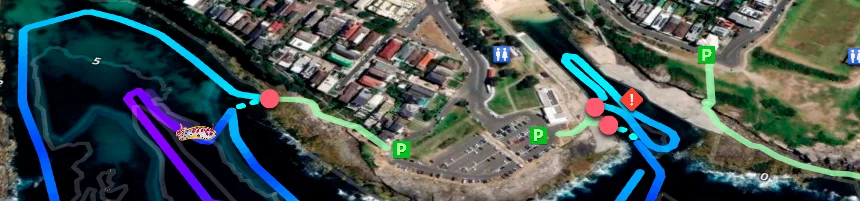
Avalon headland sits at the northern end of Avalon Beach, where a steep reef drop-off and rugged underwater terrain make it one of the more adventurous shore dives on the northern beaches. The reef descends through rocky ledges, overhangs, caves, and large boulder sections to around 18 m — the deepest site in this northern beaches group — with kelp covering the shallower sections and more complex sponge and encrusting growth appearing as depth increases. The overhangs and cave sections provide shelter for wobbegongs and hold invertebrate communities more typically associated with deeper ocean sites. The ledge structure gives the dive a pronounced vertical dimension that distinguishes it from the flatter boulder reefs at the sites to the south.
Visibility averages around 8 m and the fully exposed position at protection level 1/5 delivers strong water exchange with minimal freshwater influence at runoff 2/5. Tide sensitivity is low at 2/5 — the optimal window is incoming 2nd half, high, and outgoing 1st half — worth accounting for but not a strict planning constraint. What governs access entirely is swell and sea state. The wave limit is just 0.4 m — the most restrictive in the northern beaches batch — reflecting the fully exposed headland position and the technical nature of the entry and exit. Strong rips, currents, and swell are common, and the same mandatory safety equipment applies as across all exposed northern beaches sites: float, audible device, PLB. Only dive in genuinely flat, calm conditions with an experienced group.
DPV is a natural fit for this site. The depth range, the cave and overhang sections, and the extended ledge terrain make a scooter a practical tool for covering the site efficiently and managing any current in the deeper sections. The 18 m maximum depth approaches Advanced certification limits, and the combination of depth, exposure, and technical entry makes Avalon one of the more demanding sites on the Sydney northern beaches circuit.
Paid parking is available. There are no facilities at the site itself. Pro Dive Manly is the closest shop at 20.5 km (28 min) — the furthest drive of any site in this batch. The cave sections at Avalon are the feature most worth seeking out specifically. The reduced light inside the overhangs concentrates invertebrate settlement on the ceiling and walls in a way that the open ledge faces do not, and a torch reveals encrusting growth and resident species — including nudibranch species that require the sheltered, stable environment the caves provide — that are simply not visible in the ambient light of the open reef. The combination of cave habitat, 18 m depth, and DPV-friendly ledge terrain makes Avalon the most technically demanding and rewarding site in the northern beaches batch.
Paid parking is available at Avalon Beach. There are no on-site facilities. Pro Dive Manly is the closest shop at 20.5 km (28 min). Plan all logistics before departing.

 Site Brief
 Dive Brief
 Marine Life
 Site Access
 Nearby ServicesMore Dive Sites in Hunter