About Bass and Flinders
Shallow shore dive at the end of Cronulla Peninsula with easy entry/exit, featuring a submerged car wreck and seasonal baby Port Jackson sharks in October.
Bass and Flinders Weather Forecast
About this forecast
7-day weather forecast for Newcastle, NSW sourced from Open-Meteo. Daily high/low temperatures, conditions and rain probability.
Bass and Flinders Swell Forecast
About this forecast
Site-specific wave heights adjusted for Bass and Flinders's exposure, orientation and depth profile. Colour bands: green = ideal, orange = marginal, red = undiveable.
Bass and Flinders Tide Chart
About this chart
Today's tide chart with best at incoming or high tide conditions highlighted in green. This site dives best best at incoming or high tide. Upgrade to Essential or Pro to unlock the 5-day tide chart.



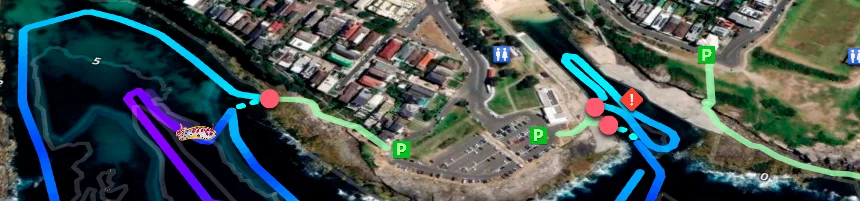
Bass and Flinders sits at the very tip of the Cronulla Peninsula where the Port Hacking River meets the open coast, and it punches well above its depth rating for variety. The reef is shallow — maxing out at 6 m — and the terrain includes rocky reef sloping to a sandy bottom, kelp beds covering the mid-section, and an unusual bonus: a small submerged car wreck that has been colonised over the years into a productive artificial reef and a reliable hiding spot for juvenile fish and invertebrates. It is a compact site that gives you more to look at than the depth alone suggests.
In October, baby Port Jackson sharks gather here in numbers, making it one of the most accessible shark nurseries on the Sydney coast. The sharks are small, entirely docile, and photogenic in the shallow water. Outside that window, night diving is the main draw — the shallow rocky reef comes alive after dark with a completely different cast of species than you encounter during the day.
Visibility is typically 5 m or better when conditions are right. The site is best dived on an incoming or high tide, and the entry and exit are easy — one of the better beginner-friendly shore entries in the Cronulla area. The main inconvenience is the walk back up the hill after the dive with full gear. Boat traffic is minimal compared to sites further into Port Hacking, but a surface float is still good practice if freediving.
The site is also suited to DPV exploration — a scooter opens up the reef beyond the immediate entry area and can take you all the way to fish soup. The site has genuine seasonal appeal beyond the standard summer peak. Port Jackson sharks aggregate at Bass and Flinders from late August through October during their annual breeding season, and the underwater terrain of boulders and kelp provides the kind of complex habitat they favour for egg-laying. Multiple sharks can be present simultaneously on a good winter or early spring dive, and because the site is relatively sheltered compared to the more exposed headlands further south, it is often diveable on days when the better-known Port Jackson shark sites are washed out. Night diving is also productive here — the kelp beds come alive with invertebrate activity after dark and the Pelagic trail covers the site to deeper walls.
Restrooms and a shower are 30 m from the entry point. Abyss Scuba Diving is the closest shop 13 km away.

 Site Brief
 Dive Brief
[Wreck Landmark] You'll pass a submerged Ford car wreck after approximately 30m — a useful reference point for your position.
[Sand Line Navigation] Follow the sand line as it veers NE. This corridor provides clear navigation and usually good visibility.
[Seasonal Wildlife] In October, watch for baby Port Jackson sharks in this area — a special encounter if conditions align.
[Reef Complexity] The reef becomes progressively more interesting as you venture further. You're transitioning into Oak Park dive site territory around 600m from entry.
[Turn & Return] Continue as far as conditions allow, but ensure you have at least half a tank remaining for the return journey.
 Marine Life
 Site Access
 Nearby ServicesMore Dive Sites in Hunter