Hunter, NSW

Bare Island Deep Wall

Shore Dive Beginner Scuba DivingFreediving Drift DiveDPV

About Bare Island Deep Wall

A dramatic dive featuring a vertical reef wall, swim-throughs, and abundant marine life, including seahorses and rays.

Live Conditions
Score
Azure™ Visibility
Predicted
Wave Height
Offshore
Wind
Knots
Features
MacroWallBouldersSponge Gardens

Bare Island Deep Wall Weather Forecast

About this forecast

7-day weather forecast for Newcastle, NSW sourced from Open-Meteo. Daily high/low temperatures, conditions and rain probability.

Bare Island Deep Wall Swell Forecast

Bare Island Deep Wall site-specific wave heights — Pelagic Hadal Conditions Intelligence™
About this forecast

Site-specific wave heights adjusted for Bare Island Deep Wall's exposure, orientation and depth profile. Colour bands: green = ideal, orange = marginal, red = undiveable.

Bare Island Deep Wall Tide Chart

Tide times and optimal dive windows — Bare Island Deep Wall, Hunter
About this chart

Today's tide chart with attempt only on an incoming tide, ideally about 2 hours before high tide conditions highlighted in green. This site dives best attempt only on an incoming tide, ideally about 2 hours before high tide. Upgrade to Essential or Pro to unlock the 5-day tide chart.

Pelagic

More to explore at Bare Island Deep Wall

Smart trails, marine life hotspots, NaviCodes™ and reef maps.

🌊 Unlock Pro
Reef Trails™
Guided underwater routes to the best reefs.
Marine Life Hotspots
Pinpointed locations for turtles, sharks and rays.
NaviCodes™
Bearings for your slate.
Reef & Wall Maps
Depth contours on the map.
Pelagic
Free to explore · Pro from $2.88/week · Ad-free All Pro features →
Dive Site Guide

Bare Island Deep Wall is the most technically demanding of the three Bare Island dives, where tidal current on an outgoing tide runs strong enough to transform the site into a genuinely hazardous proposition. Dived correctly on the incoming, it is exceptional — the vertical reef wall is covered in sponge gardens and soft corals, swim-throughs break the face at several points, seahorses cling to the kelp on the upper sections, and Weedy Sea Dragons drift along the kelp-fringed margins above the wall proper. Depth reaches 18 m and the incoming drift carries you efficiently along the wall, delivering a concentrated series of features in a single dive without requiring significant effort to maintain position.

This is not a site for uncertain navigation, marginal air consumption, or inconsistent buoyancy at depth. Plan your dive for about two hours before high tide on a clearly established incoming current, identify your exit point explicitly before entering the water, and deploy your DSMB well before beginning your ascent. The depth and drift combination can push beyond standard Open Water certification limits on the lower sections of the wall — Advanced certification and solid experience in drift conditions are appropriate prerequisites.

Flat seas are mandatory. Visibility averages around 8 m — meaningfully better than the other Bare Island sites — though a prolonged dry period beforehand helps maintain that figure. Runoff sensitivity is high; allow at least a week after rain. DPV is a natural fit for this drift wall — a scooter lets you keep station against any residual current and cover more of the wall face than fin power alone allows. Restrooms and picnic areas are near the Bare Island bridge. The Deep Wall is also the site most likely to reward repeat visits at Bare Island. The first dive here typically focuses on understanding the wall profile and the drift dynamic. Subsequent dives open up the detail — the specific sponge formations, the crevice sections between the major boulder features, and the sections of wall where the macro density is highest. DPV allows these sections to be covered systematically in a way that fin power does not, and divers who use a scooter report finding terrain on this wall that regular fin divers consistently miss because it falls beyond the comfortable turn-around point for a single-tank dive.

Mid-week dives are worth strongly considering here over weekends, when boat traffic in the surrounding water is consistently less of an ongoing concern during ascent, deco stops, and mandatory safety stops. Restrooms and picnic areas are near the Bare Island bridge. Abyss Scuba Diving is 15.8 km (20 min).

Max Depth
18m
Experience
Intermediate
Best Vis
8m
Rating
★★★★★
Site Exposure
NNEESESSWWNW
Full exposure
Partial exposure
Limited exposure
Protected
Site Exposure
Open Coast
Full exposure ESE–S. Partial exposure SW–NW. Limited exposure S–SW.
Protection Level2/5
Tide SensitivityHigh
Runoff ImpactHigh

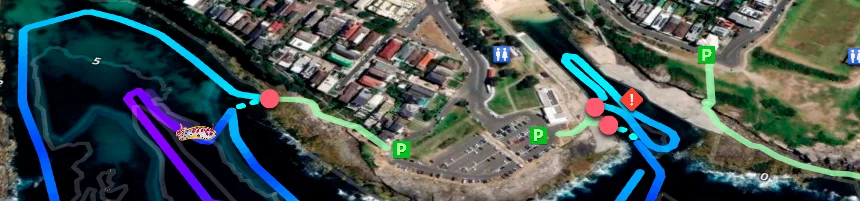
Bare Island Deep Wall Location

Open full map in Pelagic
Site Brief
Best Conditions
Flat seas, <0.5 m swell, incoming tide, no recent rain
Tide
Attempt only on an incoming tide, ideally about 2 hours before high tide
Current
Strong
Bottom
Rock wall, sponge gardens, sandy gutters
Water Temperature
Summer 22–24 °C | Winter 16–18 °C
Dive Brief
Brief
Enter from the southeastern side of the island and descend heading around the southern tip, then southwest-west until you reach a depth of approximately 16 meters. From there, turn northwest and follow the vertical reef wall, taking time to explore swim-throughs and overhangs along the way. At depths between 14–18 meters, you’ll encounter scattered bommies and sandy gutters—ideal spots for observing rays and other bottom-dwelling marine life. At around 100 bar, begin your return by heading east into shallower waters, and make your exit on the northwest-facing side of the island.
Only attemp with experience, good navigation skills and excellent air consumption. Strong tidal drift—plan dive with incoming tide. Deploy DSMB/dive flag before surfacing. Depth and drift may exceed Open Water limits.
Marine Life
Weedy seadragons, pygmy pipehorses, nudibranchs, Port Jackson & Wobbegong sharks, stingrays, moray eels, schools of yellowtail
Site Access
Access
Park near Bare Island footbridge, cross to island and use stairs on left down to the rock platform, then to your right.
Parking
Park on Anzac Parade as close to the footbridge path as possible.
Fees
None
Facilities
Nearby restrooms and picnic areas
Nearby Services
Dive Shops
Abyss Scuba Diving (15.8 km / 20 min)
Common Questions
How deep is Bare Island Deep Wall?
Bare Island Deep Wall reaches a maximum depth of 18m. Suitable for divers with some open water experience.
Is Bare Island Deep Wall suitable for beginners?
Bare Island Deep Wall is best suited to intermediate divers with at least 20–30 logged dives and comfortable buoyancy control.
What is the visibility like at Bare Island Deep Wall?
Pelagic's Azure™ model predicts an expected visibility of around 8m at Bare Island Deep Wall. Typical visibility is 5 m. Visibility varies with swell, rainfall and tidal conditions — check the live prediction above before heading out.
When is the best time to dive Bare Island Deep Wall?
Flat seas, <0.5 m swell, incoming tide, no recent rain. Use the tide chart and swell forecast above to plan your entry window.
Can you snorkel at Bare Island Deep Wall?
Scuba Diving, Freediving are all well suited to Bare Island Deep Wall. The site is rated intermediate level.
Are there any hazards at Bare Island Deep Wall?
Only attemp with experience, good navigation skills and excellent air consumption. Strong tidal drift—plan dive with incoming tide. Deploy DSMB/dive flag bef… See the Hazards section below for full details.
What is the water temperature at Bare Island Deep Wall?
Summer 22–24 °C | Winter 16–18 °C — summer to winter range. A 5mm wetsuit is recommended for winter, while a 3mm or shorty is fine in summer.
🌊 Open on the Pelagic Map
Live visibility, diver reports and marine life sightings — all in one place. Free to use.
Open in Pelagic — Free