About Bare Island Deep Wall
A dramatic dive featuring a vertical reef wall, swim-throughs, and abundant marine life, including seahorses and rays.
Bare Island Deep Wall Weather Forecast
About this forecast
7-day weather forecast for Sydney, NSW sourced from Open-Meteo. Daily high/low temperatures, conditions and rain probability.
Bare Island Deep Wall Swell Forecast
About this forecast
Site-specific wave heights adjusted for Bare Island Deep Wall's exposure, orientation and depth profile. Colour bands: green = ideal, orange = marginal, red = undiveable.
Bare Island Deep Wall Tide Chart
About this chart
Today's tide chart with attempt only on an incoming tide, ideally about 2 hours before high tide conditions highlighted in green. This site dives best attempt only on an incoming tide, ideally about 2 hours before high tide. Upgrade to Essential or Pro to unlock the 5-day tide chart.



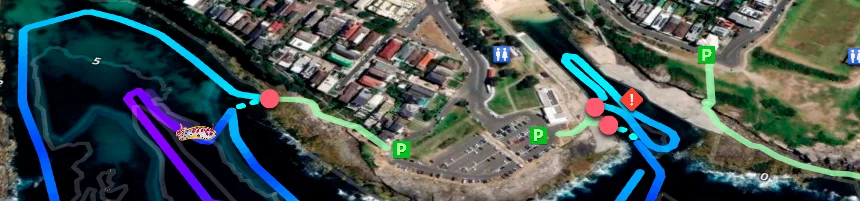
Bare Island Deep Wall is the most technically demanding of the three Bare Island dives, where tidal current on an outgoing tide runs strong enough to transform the site into a genuinely hazardous proposition. Dived correctly on the incoming, it is exceptional — the vertical reef wall is covered in sponge gardens and soft corals, swim-throughs break the face at several points, seahorses cling to the kelp on the upper sections, and Weedy Sea Dragons drift along the kelp-fringed margins above the wall proper. Depth reaches 18 m and the incoming drift carries you efficiently along the wall, delivering a concentrated series of features in a single dive without requiring significant effort to maintain position.
This is not a site for uncertain navigation, marginal air consumption, or inconsistent buoyancy at depth. Plan your dive for about two hours before high tide on a clearly established incoming current, identify your exit point explicitly before entering the water, and deploy your DSMB well before beginning your ascent. The depth and drift combination can push beyond standard Open Water certification limits on the lower sections of the wall — Advanced certification and solid experience in drift conditions are appropriate prerequisites.
Flat seas are mandatory. Visibility averages around 8 m — meaningfully better than the other Bare Island sites — though a prolonged dry period beforehand helps maintain that figure. Runoff sensitivity is high; allow at least a week after rain. DPV is a natural fit for this drift wall — a scooter lets you keep station against any residual current and cover more of the wall face than fin power alone allows. Restrooms and picnic areas are near the Bare Island bridge. The Deep Wall is also the site most likely to reward repeat visits at Bare Island. The first dive here typically focuses on understanding the wall profile and the drift dynamic. Subsequent dives open up the detail — the specific sponge formations, the crevice sections between the major boulder features, and the sections of wall where the macro density is highest. DPV allows these sections to be covered systematically in a way that fin power does not, and divers who use a scooter report finding terrain on this wall that regular fin divers consistently miss because it falls beyond the comfortable turn-around point for a single-tank dive.
Mid-week dives are worth strongly considering here over weekends, when boat traffic in the surrounding water is consistently less of an ongoing concern during ascent, deco stops, and mandatory safety stops. Restrooms and picnic areas are near the Bare Island bridge. Abyss Scuba Diving is 15.8 km (20 min).

 Site Brief
 Dive Brief
 Marine Life
 Site Access
 Nearby ServicesMore Dive Sites in Sydney