About Cabbage Tree Bay, Manly
Shelly Beach is Sydney’s most visited dive site, known for its calm, shallow conditions within a marine sanctuary. A boulder slope on the right leads to a sandy bottom, while the left side features kelp gardens that shelter a wide variety of marine life.


Cabbage Tree Bay, Manly 7-Day Weather Forecast
About this forecast
7-day weather forecast for Sydney, NSW sourced from Open-Meteo. Shows daily high/low temperatures, weather conditions and rain probability — useful for planning your drive to Cabbage Tree Bay, Manly.
Cabbage Tree Bay, Manly 7-Day Swell & Wave Height Forecast
About this forecast
7-day swell forecast for Cabbage Tree Bay, Manly, calculated using Pelagic's Hadal Conditions Intelligence™. Wave heights are site-specific — adjusted for Cabbage Tree Bay, Manly's exposure, orientation and depth profile. Colour bands show diveable conditions at this site: green is ideal, orange is marginal, red is undiveable.
Optimal Dive Times & Tide Chart — Cabbage Tree Bay, Manly
About this chart
5-day tide chart for Cabbage Tree Bay, Manly showing high and low tides with best on incoming to high tide conditions highlighted as green. Tidal movement directly affects visibility and current strength at Cabbage Tree Bay, Manly — plan your entry to coincide with the green windows for the best conditions.
Tide data is site-specific and accounts for Cabbage Tree Bay, Manly's tidal sensitivity. This site dives best best on incoming to high tide.



Dive Site Guide
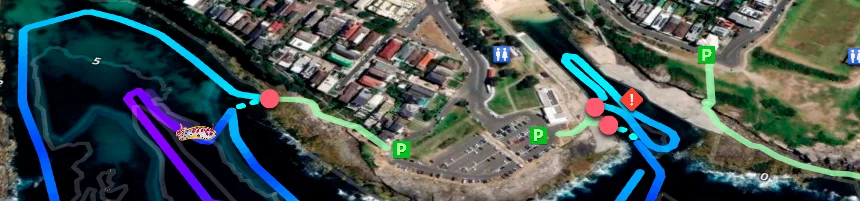
Cabbage Tree Bay at Shelly Beach in Manly is the most visited dive site in Sydney and almost certainly the most dived snorkel and scuba location on the east coast. The bay is an aquatic reserve — no fishing, no collecting, no anchoring — and the protection has produced marine life density and approachability that justify the reputation entirely. The bay is divided into two distinct dive environments: the right side features a boulder slope descending to a sandy bottom, populated by Eastern Blue Gropers, wobbegongs, rays, and schooling fish; the left side delivers kelp gardens and seagrass beds that hold cuttlefish, seahorses, pipefish, and nudibranchs in habitat that rewards slow, careful searching. The maximum depth of 10 m keeps the site accessible to all certification levels.
Giant cuttlefish are one of the signature species and are found year-round, though encounters are most reliable in the cooler months. Green turtles visit the bay and are a genuine possibility on any dive — maintain a minimum 3 m distance and never block their path to the surface. DPV is actively used at this site and suits the layout well, allowing efficient coverage of both the boulder slope and the kelp garden sections in a single dive. The combination of easy access, guaranteed marine life, and the aquatic reserve protection makes Cabbage Tree Bay the logical first dive for anyone new to Sydney.
Unlike the other Manly harbour sites, Cabbage Tree Bay has minimal tide sensitivity at 1/5 and all tide phases are listed as optimal — this is the most open of the Manly area sites in terms of tidal influence and you do not need to plan around a specific tidal window. Runoff sensitivity is also just 1/5, meaning rainfall has minimal impact on water quality here. Visibility averages around 9 m and the moderate protection level of 3/5 means light swell occasionally reaches the bay, though the site is diveable in a wide range of conditions.
Sediment sensitivity is moderate at 3/5 — buoyancy control matters here, particularly in the kelp garden sections where disturbed particulate takes time to settle. Paid parking applies at Shelly Beach. Public bathrooms, showers, large gear-up tables, and a cafe are on site. The site is best combined with an awareness of the seasonal cuttlefish patterns. Giant cuttlefish are present year-round but are most active and most visibly engaged in hunting and courtship behaviour during autumn and winter — May through August produces the most reliable encounters. The turtles that visit the bay are not guaranteed on any given dive, but local dive operators and regular site visitors report them frequently enough that it is worth scanning the surface of the kelp garden on every dive. Weekday dives or early weekend starts significantly reduce in-water crowding at this popular site.
Dive Centre Manly is the closest shop at 2.3 km (6 min).


