About Oak Park
This dive trail leads freedivers and snorkelers through shallow waters north of Oak Park to the striking boulder fields at Windy Point.
Oak Park Weather Forecast
About this forecast
7-day weather forecast for Sydney, NSW sourced from Open-Meteo. Daily high/low temperatures, conditions and rain probability.
Oak Park Swell Forecast
About this forecast
Site-specific wave heights adjusted for Oak Park's exposure, orientation and depth profile. Colour bands: green = ideal, orange = marginal, red = undiveable.
Oak Park Tide Chart
About this chart
Today's tide chart with better visibility at high or incoming tide conditions highlighted in green. This site dives best better visibility at high or incoming tide. Upgrade to Essential or Pro to unlock the 5-day tide chart.



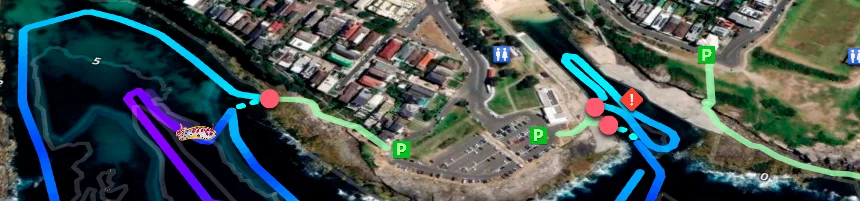
Oak Park is one of the most reliable and approachable shore dives in the Sutherland Shire, and it consistently delivers more than its modest rating suggests. The defining feature is the wall — a continuous rocky drop-off running straight out to sea, draped in sponge gardens and kelp and riddled with overhangs that shelter resting Wobbegongs, crayfish, and sleeping reef fish. The resident Eastern Blue Gropers here are famously unbothered by divers, often swimming alongside or actively approaching — one of the more endearing encounters on any Sydney dive, and a reliable one at that.
Depth maxes out at 10 m and the terrain is easy to navigate, making this a strong option for less experienced divers and a quick, satisfying dive for anyone passing through the area. Visibility ranges from 3 m on a poor day to 10 m-plus in good conditions. The final hours of an incoming tide improves clarity noticeably by pushing cleaner oceanic water across the reef, and the site is best avoided for at least a week after heavy rain when Port Hacking runoff floods through. The site is well protected from southerly winds and swell but exposed to easterlies and northerlies — check the Pelagic forecast before heading out.
The wall rewards a slow and methodical search for macro life. Nudibranchs appear regularly on the sponge-covered sections, and the crevices in the overhangs often contain species that a diver moving at pace will simply miss. The cave further out adds further exploration, and the site is well suited for DPVs — a scooter lets you cover the full wall length efficiently and extend the dive beyond the immediate entry area to fish soup.
Blue-ringed octopus are an occasional find in the crevices along the lower wall — small, well-camouflaged, and not aggressive unless handled, but worth knowing about at a site where fingers instinctively reach into crevices. Oak Park is also worth revisiting at different points through the year. Winter brings the clearest visibility and the most active invertebrate life on the sponge gardens, while summer draws the Blue Gropers into shallower, more photogenic positions and occasionally brings tropical species south on the East Australian Current. Night diving here is underrated — the wall in torch-only light reads as an entirely different site, and species that are invisible during the day emerge across the sponge surfaces after dark.
The Oak Park Pavilion has public toilets, changing facilities, and showers. The adjacent park has BBQs and a playground — a practical setup for a day trip with non-divers who can enjoy the foreshore while you dive. Abyss Scuba Diving is the nearest shop 12.6 km away.

 Site Brief
 Dive Brief
 Marine Life
 Site Access
 Nearby ServicesMore Dive Sites in Sydney