About Bilgola Beach
Bilgola reef provides an interesting dive over rocky outcrops — ideal for spotting octopus, leatherjackets, and fish that shelter around submerged boulders.
Bilgola Beach Weather Forecast
About this forecast
7-day weather forecast for Sydney, NSW sourced from Open-Meteo. Daily high/low temperatures, conditions and rain probability.
Bilgola Beach Swell Forecast
About this forecast
Site-specific wave heights adjusted for Bilgola Beach's exposure, orientation and depth profile. Colour bands: green = ideal, orange = marginal, red = undiveable.
Bilgola Beach Tide Chart
About this chart
Today's tide chart with best on incoming mid to high tide conditions highlighted in green. This site dives best best on incoming mid to high tide. Upgrade to Essential or Pro to unlock the 5-day tide chart.



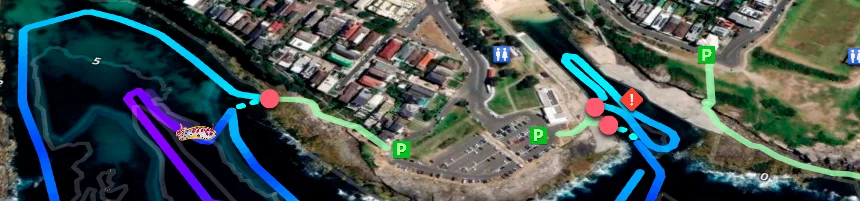
Bilgola Beach sits between Avalon and Newport on the northern beaches, where a rocky reef extends from the southern headland over a trail that covers 1.3 km of underwater terrain to around 12 m. The reef structure features rocky outcrops, kelp patches, and a small drop-off, with the crevices and boulder sections providing habitat for the species that characterise this stretch of coast. Octopus are found consistently in the rocky crevices throughout the site. Leatherjackets move through the kelp patches and around the boulders. Fish shelter around the submerged boulder sections and the drop-off edge concentrates schooling species at the deeper end of the profile. The 1.3 km trail length means there is more terrain here than most single dives can fully cover — planning a route and turnaround point before entering is important for managing gas efficiently.
Visibility averages around 8 m and the open ocean position at protection level 1/5 delivers clean water exchange. Tide sensitivity is low at 2/5 — the optimal window is incoming 2nd half, high, and outgoing 1st half — a mild preference rather than a hard requirement, with only a small visibility penalty outside that window. Runoff sensitivity is similarly low at 2/5, meaning recent rainfall is not a significant planning factor. The wave limit is 0.5 m and the full northern beaches conditions caution applies: strong rips, currents, and swell are possible; dive only in flat, calm conditions with a group; carry a float, audible device, and ideally a PLB.
The trail length introduces a navigation consideration that shorter sites do not. Only continue as far as your equipment, gas, and skill level permit — the GeoJSON warning explicitly flags this point. Turning back at the midpoint on an initial visit is sensible practice for a site of this extent before committing to the full trail on a subsequent dive.
There are no facilities at Bilgola Beach. Pro Dive Manly is the closest shop at 16.9 km (28 min). The site also rewards a thoughtful approach to the trail structure. The first third of the reef from the entry point covers the most accessible terrain and is where the highest species density tends to be concentrated. The middle section includes the drop-off edge, which is the best terrain for schooling fish and the deeper ledge species. The outer third of the 1.3 km trail is for experienced divers with good gas management — conditions are more exposed and the return to entry requires enough reserve to swim back in any current that has developed during the dive. A pre-planned turnaround pressure rather than a time-based plan suits this site well.
There are no facilities at Bilgola Beach. Pro Dive Manly is the closest shop at 16.9 km (28 min). Plan all logistics including tank fills and a conditions check before committing to the drive.

 Site Brief
 Dive Brief
 Marine Life
 Site Access
 Nearby ServicesMore Dive Sites in Sydney