About Freshwater
Rugged rocky trenches, sharp drop-offs, and thriving schools of fish, makes Freshwater one of the premier dive sites on the northern beaches.
Freshwater Weather Forecast
About this forecast
7-day weather forecast for Sydney, NSW sourced from Open-Meteo. Daily high/low temperatures, conditions and rain probability.
Freshwater Swell Forecast
About this forecast
Site-specific wave heights adjusted for Freshwater's exposure, orientation and depth profile. Colour bands: green = ideal, orange = marginal, red = undiveable.
Freshwater Tide Chart
About this chart
Today's tide chart with best at slack high tide conditions highlighted in green. This site dives best best at slack high tide. Upgrade to Essential or Pro to unlock the 5-day tide chart.



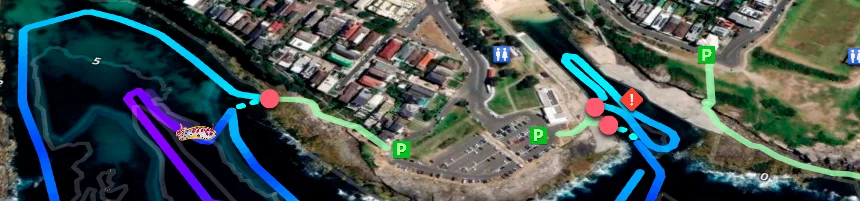
Freshwater is one of the premier dive sites along Sydney's northern beaches — a rugged headland site at the southern end of Freshwater Beach where rocky trenches, sharp drop-offs, and overhangs create the kind of complex, three-dimensional terrain that rewards repeated dives and careful exploration. The reef structure drops through a series of ledges and rocky overhangs to around 13 m, with sand, sponge, and kelp filling the spaces between the major formations. Schooling fish are the signature feature — the trenches and drop-offs concentrate species in a way that open reef terrain cannot, and the fish density here is consistently high by northern beaches standards. Wobbegongs rest on the overhangs and under the ledges. Rays move across the sandy sections between the reef structures.
Visibility averages around 11 m — among the higher figures for a northern beaches shore dive — driven by the open ocean position at protection level 2/5 and minimal freshwater influence at runoff 1/5. Tide sensitivity is 1/5 with all phases optimal, so tidal timing is not a factor in planning. What matters here is swell height and direction — the site is fully usable in calm conditions and becomes progressively more difficult as swell picks up, with the eastern entry and exit point specifically requiring avoidance in any meaningful swell. The wave limit is 0.5 m and the site should not be dived above that threshold unless conditions are thoroughly assessed.
Two entry points serve the site. The eastern entry gives direct access to the better terrain but is exposed to swell and surge — avoid it when swell is above 0.5 m. The western entry is more sheltered and remains viable in slightly larger conditions. Divers unfamiliar with the site should use the western entry on their first visit regardless of conditions and assess the eastern approach once they have a clear picture of the reef layout from below.
The trench and drop-off sections are the most rewarding terrain and are best explored early in the dive before gas and no-decompression time constrain how far into the structure you can go. A paid carpark is available at the beach; on-street parking is free. Restrooms and showers are adjacent to the ocean pool. Freshwater also has good seasonal variation. The trench and drop-off sections are most productive from June through October when the water cools to around 16–17°C and invertebrate activity on the overhangs is at its peak. Nudibranch diversity increases through this period, and the schooling fish behaviour changes — tighter schools, more pronounced movement — as the thermal gradient shifts. Summer brings warmer water and occasional tropical visitors from further north. Planning a visit specifically during the calm spell after a northerly wind — when the sea flattens and visibility peaks — consistently produces the best conditions this site offers.
Pro Dive Manly is the closest shop at 2.6 km (6 min), with Dive Centre Manly at 4.2 km (8 min).

 Site Brief
 Dive Brief
 Marine Life
 Site Access
 Nearby ServicesMore Dive Sites in Sydney