About Little Bay
Small, sheltered bay framed by rocky headlands. Calm, clear waters and easy shore entry make it a tranquil gem.
Little Bay Weather Forecast
About this forecast
7-day weather forecast for Sydney, NSW sourced from Open-Meteo. Daily high/low temperatures, conditions and rain probability.
Little Bay Swell Forecast
About this forecast
Site-specific wave heights adjusted for Little Bay's exposure, orientation and depth profile. Colour bands: green = ideal, orange = marginal, red = undiveable.
Little Bay Tide Chart
About this chart
Today's tide chart with best around high tide for entry/exit ease conditions highlighted in green. This site dives best best around high tide for entry/exit ease. Upgrade to Essential or Pro to unlock the 5-day tide chart.



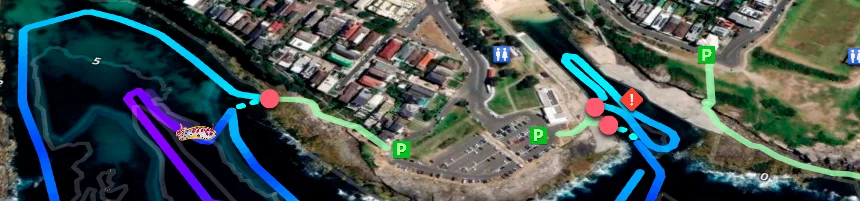
Little Bay is a small, rocky-headland bay on Sydney's southern coastline that offers significantly more underwater interest than its modest profile suggests. The reef system runs from the surface to 21 m, with swim-throughs cutting through the boulder fields, kelp beds covering the mid-depth zone, and sandy channels running between the reef sections at depth. Visibility is genuinely good by Sydney standards at 8–15 m, and the sheltered bay aspect keeps conditions manageable even when the coast immediately north and south is roughed up. It is one of the few Sydney shore dives where a beginner-accessible entry coexists with a 21 m maximum depth — the shallower zones suit new divers while the deeper sections reward experienced ones. The site is also excellent for night diving, when the cave sections and boulder fields come alive with nocturnal species, and well-suited to DPV for covering the swim-throughs and deeper reef efficiently.
Entry is easy via the beach or rock platform. Avoid swell above 0.5 m as the rock pool entry becomes uncomfortable quickly and the exit increasingly hazardous. The apex shark caveat here is worth taking seriously: bull and white sharks are occasionally sighted outside the bay, particularly at dawn and dusk. Diving in a group, avoiding those time windows, surfacing with a DSMB clearly deployed, and being alert when rock fishermen are present — whose bait and catch can attract large animals inshore — are all straightforward precautions that apply here.
Visibility and water quality both degrade for several days after rain, so check conditions after any significant weather before visiting. Restrooms and showers are at the top of the beach stairs, with a café adjacent to the chapel nearby. Little Bay is also one of the better Sydney sites for understanding how protection level affects dive conditions. At prot_lvl 4/5 — well sheltered by the standards of the Eastern Suburbs ocean sites — it absorbs a meaningful amount of swell and remains diveable in conditions that would close out Shark Point or the Clovelly headland sites. The trade-off is a slightly more complex tidal picture than the fully open ocean sites: the sheltered bay position means tidal movement has some influence on water quality, though with tide sensitivity of only 2/5 this is a minor factor rather than a governing one. The swim-throughs and cave sections that define the site are best explored methodically rather than rushed — take time to stop inside each section and let your eyes adjust before moving on.
The bay is worth viewing from the headland before entering — the rocky shelf, entry point, and open coast boundary are all visible from above and provide useful orientation. Restrooms and showers are at the top of the beach stairs, with a café adjacent to the chapel. Pro Dive Alexandria is 11.5 km (21 min) and Abyss Scuba Diving is 15.5 km (22 min).

 Site Brief
 Dive Brief
 Marine Life
 Site Access
 Nearby ServicesMore Dive Sites in Sydney