About Mackenzies Bay
Tucked between Bondi and Tamarama, stunning Mackenzies Bay reveals hidden underwater gems for those who venture out to the point—perfect for scuba and freediving in calm conditions.
Mackenzies Bay Weather Forecast
About this forecast
7-day weather forecast for Sydney, NSW sourced from Open-Meteo. Daily high/low temperatures, conditions and rain probability.
Mackenzies Bay Swell Forecast
About this forecast
Site-specific wave heights adjusted for Mackenzies Bay's exposure, orientation and depth profile. Colour bands: green = ideal, orange = marginal, red = undiveable.
Mackenzies Bay Tide Chart
About this chart
Today's tide chart with high tide for safer entry and exit conditions highlighted in green. This site dives best high tide for safer entry and exit. Upgrade to Essential or Pro to unlock the 5-day tide chart.



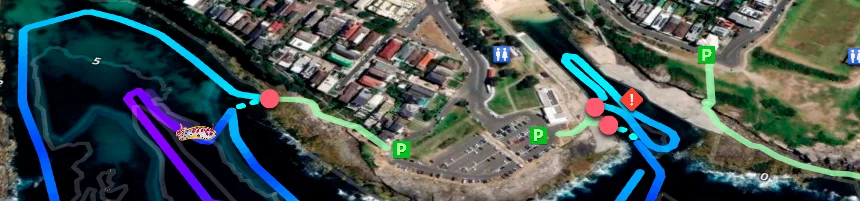
Mackenzies Bay sits between Bondi and Tamarama, tucked into a rocky headland that most beach visitors walk straight past. For divers willing to make the entry, the bay reveals a reef system of rock shelves, ledges, and kelp beds that extends out toward the point and drops to around 12 m, with the DPV trail continuing deeper to 26 m beyond the immediate bay area. Grey Nurse sharks are associated with the point, and the fish life along the rocky reef — wrasse, leatherjackets, wobbegongs resting under the ledges, blue gropers moving through the kelp — is typical of high-quality Sydney reef but denser than many more accessible sites. The position between two beaches gives it a sheltered quality on calm days that belies the fully exposed ocean setting.
Visibility averages around 8.5 m and the site holds consistently well because the open ocean position delivers strong water exchange with minimal freshwater influence — runoff sensitivity is 1/5. Tide sensitivity is equally low at 1/5 with all phases optimal, though high tide is preferred for the practical reason of an easier entry and exit over the rocky access point at Tamarama. The site is fully exposed at protection level 1/5 and the wave limit is 0.5 m. Surf, rip currents, and shore break are all present at Tamarama in elevated swell and require careful assessment before entering the water. Anything above 0.5 m and the entry becomes hazardous.
The DPV trail beyond the sheltered bay section is more exposed to current and surge than the interior, and divers should be comfortable managing those conditions before venturing further toward the point. Navigation around the reef drops carries a disorientation risk in reduced visibility or current — plan your route before entering and maintain a bearing back to the entry point throughout the dive. DPV is a practical choice for covering both the bay and the outer point efficiently in a single dive. A DSMB is essential given the open water proximity and the boat traffic that passes outside the bay.
The site also offers genuine seasonal variation. Grey Nurse sharks are more consistently sighted here during the cooler months when they aggregate near the headland, and the kelp on the reef beds is at its densest in winter, providing more complex habitat and more consistent cuttlefish and leatherjacket encounters. In the warmer months the fish activity increases in the shallower sections of the bay and the visibility tends to improve as the water stratifies and surface turbulence reduces on calm days.
There are no fees. Restrooms, a cafe, and showers are at Tamarama Beach. Dive Centre Bondi is the closest shop at just 1.4 km (3 min).

 Site Brief
 Dive Brief
 Marine Life
 Site Access
 Nearby ServicesMore Dive Sites in Sydney