About Manly Gasworks
This shallow coastal dive winds past old sea walls and scattered relics from Sydney’s gas-making era, with rays, octopus, and historic debris hidden among the silt and stone.
Manly Gasworks Weather Forecast
About this forecast
7-day weather forecast for Sydney, NSW sourced from Open-Meteo. Daily high/low temperatures, conditions and rain probability.
Manly Gasworks Swell Forecast
About this forecast
Site-specific wave heights adjusted for Manly Gasworks's exposure, orientation and depth profile. Colour bands: green = ideal, orange = marginal, red = undiveable.
Manly Gasworks Tide Chart
About this chart
Today's tide chart with best at high tide conditions highlighted in green. This site dives best best at high tide. Upgrade to Essential or Pro to unlock the 5-day tide chart.



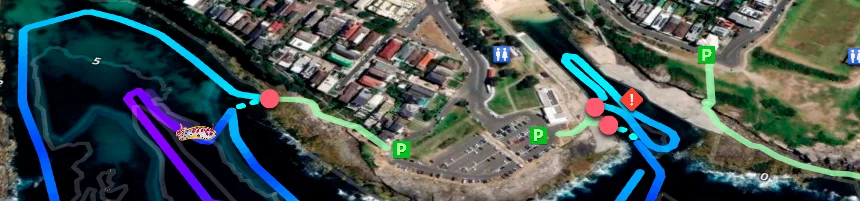
Manly Gasworks is a historically layered shore dive on the Manly Cove foreshore, where the remnants of Sydney's gas-making era lie scattered among the boulders and silt beneath a shallow coastal wall. The broken concrete, coal fragments, and historic debris from the former gasworks infrastructure create a substrate that is genuinely unlike any other Sydney dive site — a combination of natural reef and industrial artefact that rewards the kind of close, slow searching that dedicated wreck and history divers apply to deeper sites. Rays are commonly encountered moving across the sandy and silty sections. Octopus use the broken concrete as den sites. Nudibranchs appear on the encrusted wall faces, and the boulder sections hold the standard complement of harbour reef species.
The historic element is the defining quality of this site and the reason to visit it specifically rather than the more prominent Manly Cove sites nearby. The debris field is spread across a shallow area that can be covered methodically on a single dive, and the combination of natural harbour ecology growing on and around the industrial remnants gives underwater photographers an unusual compositional opportunity. A torch is useful for illuminating the detail in the debris sections and the crevices in the broken concrete.
Tide sensitivity is high at 4/5 and the optimal window is incoming 2nd half and high tide. Visibility averages around 7 m in good conditions and is closely tied to tidal phase and recent rainfall. Avoid the site for at least four days after heavy rain — runoff sensitivity is 3/5 and visibility can drop significantly and remain poor for several days after significant catchment rainfall. The entry under the bridge involves rocky terrain and requires confident footing — do not attempt if you struggle with balance on uneven surfaces.
Boat traffic overhead is a constant consideration — always use a dive float with flag or DSMB when surfacing. Be aware of sharp and potentially rusty debris throughout the dive. The site has a park with a BBQ grill nearby but no dive-specific facilities. The site has a very high protection level of 5/5, meaning ocean swell does not affect diving conditions here. On days when the Manly headland sites and the southern harbour foreshore are too exposed, Manly Gasworks remains calm and accessible. The trade-off is that the combination of low depth, silt substrate, and harbour position means it is one of the more conditions-dependent sites in terms of water quality — when it is clear it is excellent, and when it is murky after rain or at the wrong tide it is considerably less so. Picking the right conditions window is the most important preparation for this site.
Dive Centre Manly is the closest shop at 1.5 km (5 min).

 Site Brief
 Dive Brief
 Marine Life
 Site Access
 Nearby ServicesMore Dive Sites in Sydney