About North Bondi
North Bondi is a diver’s playground of endless boulder fields, crowned by the Cathedral Cave—an ethereal swim-through that feels like entering another world.
North Bondi Weather Forecast
About this forecast
7-day weather forecast for Sydney, NSW sourced from Open-Meteo. Daily high/low temperatures, conditions and rain probability.
North Bondi Swell Forecast
About this forecast
Site-specific wave heights adjusted for North Bondi's exposure, orientation and depth profile. Colour bands: green = ideal, orange = marginal, red = undiveable.
North Bondi Tide Chart
About this chart
Today's tide chart with best at high tide for easier entry and clearer visibility conditions highlighted in green. This site dives best best at high tide for easier entry and clearer visibility. Upgrade to Essential or Pro to unlock the 5-day tide chart.



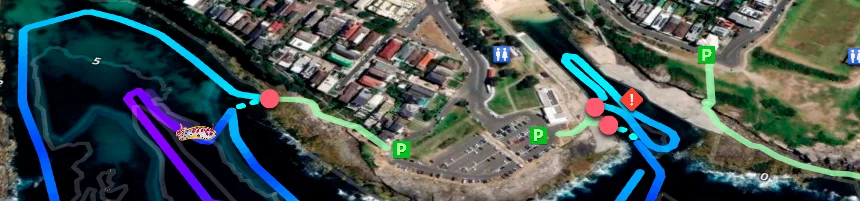
North Bondi is defined by its boulder fields — an extensive, complex reef system that slopes away from the shoreline and produces a dive that rewards navigation skill and site familiarity as much as marine life encounters. The Cathedral Cave is the headline feature: a swim-through that earns its name from the quality of filtered light that fills its interior, giving the space an atmosphere that experienced Sydney divers consistently describe as one of the finest single underwater features on the shore dive circuit. Beyond Cathedral Cave, the boulder fields extend well beyond what a single dive can cover, and the DPV trail pushes to 26 m for those wanting to explore the deeper sections efficiently and methodically.
Visibility averages around 9 m and holds consistently well. The open ocean position at protection level 1/5 delivers strong water exchange and the runoff sensitivity is just 1/5, meaning rainfall has essentially no impact on water quality here. Tide sensitivity is 1/5 with all phases listed as optimal, so there is no tidal constraint on planning. The governing factor is surface conditions: the site is fully exposed and the wave limit is 0.6 m. Entry is hazardous at low tide or with significant swell, and currents near the northern point can be stronger than the more sheltered bay section suggests. Careful timing of the approach to the water is important, particularly when any swell is running.
Navigation is the other serious consideration. The boulder fields are disorienting by design — the terrain looks similar across a wide area and a diver who loses their bearings in reduced visibility can struggle to locate the exit. Learn the site orientation and key landmarks on the surface before the first dive, keep a compass bearing throughout, and surface regularly to recheck position if uncertain. A DSMB is essential given the open ocean proximity and passing boat traffic. DPV divers should plan their route carefully — the deeper DPV trail takes you away from the main entry area and requires confident navigation to return efficiently.
The Cathedral Cave is best experienced on the way into the dive rather than as a turnaround point — approach it with a full tank and take time to settle inside and observe the light quality and the species sheltering in the chamber before continuing deeper into the boulder field. Wobbegongs are frequently found resting inside the cave structure, and the ceiling and walls carry encrusting growth that rewards a slow look with a torch. The DPV trail beyond is a different dive character entirely — open reef terrain at depth rather than the sheltered boulder navigation of the shallower sections.
There are no fees. Showers, restrooms, cafes, and restaurants are available at Bondi Beach nearby. Dive Centre Bondi is the nearest shop at 2.7 km (7 min).

 Site Brief
 Dive Brief
 Marine Life
 Site Access
 Nearby ServicesMore Dive Sites in Sydney