About Shark Point
One of Sydney's best shore dives, featuring deep sponge gardens and boulder reefs that drop off to 22 meters.
Shark Point Weather Forecast
About this forecast
7-day weather forecast for Sydney, NSW sourced from Open-Meteo. Daily high/low temperatures, conditions and rain probability.
Shark Point Swell Forecast
About this forecast
Site-specific wave heights adjusted for Shark Point's exposure, orientation and depth profile. Colour bands: green = ideal, orange = marginal, red = undiveable.
Shark Point Tide Chart
About this chart
Today's tide chart with low tide for safest entry/exit conditions highlighted in green. This site dives best low tide for safest entry/exit. Upgrade to Essential or Pro to unlock the 5-day tide chart.



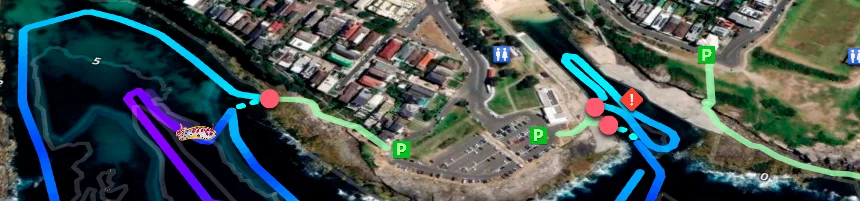
Shark Point in Clovelly is consistently ranked among the best shore dives in Sydney, and the reputation is well earned. The site drops from the rocky entry ledge through large boulder fields and sponge gardens to around 22–26 m, with the deeper sections producing some of the finest temperate reef scenery in the city. The boulders are densely colonised by sponge growth, kelp forests occupy the shallower zones, and sand channels wind between the larger formations providing natural navigation routes. Grey Nurse sharks are reported at the site, and the resident fish population — Blue Gropers, large wrasse, leatherjackets, and schooling baitfish — reflects the quality of the habitat below. The sponge gardens at depth are genuinely impressive and rival boat dive destinations that require significantly more logistical effort to reach.
Visibility averages around 13 m — among the highest expected figures for any Sydney shore dive — driven by the open ocean position at protection level 2/5 and minimal freshwater influence. Runoff sensitivity is just 1/5, meaning rainfall has virtually no impact on water quality. Tide sensitivity is equally low at 1/5 with all phases optimal, so conditions planning focuses entirely on swell and wind. Current is usually from the north and experienced divers can use this to work efficiently along the boulder fields rather than fighting it. The wave limit is 0.5 m — above that the entry becomes dangerous and the site should not be attempted.
The entry and exit are the most serious constraint this site presents. The rocky ledge is exposed to surge even in relatively modest conditions, and the combination of slippery rock, unpredictable surge, and the possibility of a wave set arriving mid-entry makes this a genuinely hazardous access point for anyone unfamiliar with it. Only dive in excellent conditions and preferably with a guide on the first visit. Buoyancy discipline is also important throughout — the sponge gardens at depth are delicate and proximity to the boulders without precise control damages them.
The deeper sections of Shark Point also hold seasonal interest — Port Jackson sharks are present through the cooler months from July to October, and the sponge garden boulders provide the kind of stable, complex habitat that concentrates species across all seasons. Underwater photographers rate this site highly for both wide-angle reef shots, where the boulder and sponge structure provides a compelling foreground, and macro work in the crevices and wall sections between the larger formations.
There are no fees. Public restrooms are in Burrows Park to the north. Dive Centre Bondi is the nearest shop at 3.8 km (8 min).

 Site Brief
 Dive Brief
 Marine Life
 Site Access
 Nearby ServicesMore Dive Sites in Sydney